
The Price of Passion: A Review of The Agitator’s Daughter
July 29, 2011
 John Cashin’s death in March has renewed interest in Sheryll Cashin’s 2008 memoir The Agitator’s Daughter. It is the story of her father’s political fortune, his rise and fall and the price of passion as told by a precocious daughter coming of age in Huntsville Alabama during the height of the civil rights movement. She shares how family wealth dissipated with the moderate success of John Cashin’s political commitment. In the early 70s as a student at Fisk University I had the opportunity to hear Dr. Cashin speak. At the time uninterested in his subject, politics, I remember being struck by his energy. He had an almost larger than life presence, confident, boastful and driven. Sheryll Cashin’s story bears out this impression.
John Cashin and brother, Herschel, during their Omega partying days at Fisk made a pledge to continue the work of their great grandfather Herschel V. Cashin a radical Republican legislator in Reconstruction Alabama. The legislator’s political career like most African American office holders ended with Reconstruction and the disenfranchisement of African Americans sweeping the South. Brother Herschel studied law unable to earn a living in Alabama when the State enacted Jim Crow legislation depriving those studying out of state the right to practice leaving John Cashin alone to fulfill their fraternal pledge.
John Cashin became a dentist joining his father in a successful Huntsville Alabama practice. After military service and a tour in France he would return home to finish grand father Herschel’s work founding the National Democratic Party of Alabama in 1968. The Party became a prominent voice for Black voting rights and an important player in local politics in Black-dominated communities. It began the process of dismantling the segregationist chokehold on Alabama’s political process.
The Party in the name of Black voting rights would enjoy successes and suffer defeats until its demise in 1976 at a time when John Cashin’s reversal of fortune and personal calamities would mount. Sheryll Cashin laments the price her father paid for his commitment. A bitterness evolves to acceptance enabling the Georgetown law professor to no less carry on a family tradition of service and good works. Her memoir is an inspiring historical account delving into morality and the price of passion.
Pamela Samuels Young
March 24, 2011

Murder on the Down Low opens at the funeral of Maya Washington. Mourning are her close knit girlfriends. Maya died of AIDS infected by her down low fiancé, Eugene Nelson. Her cousin Special Moore full of vengeful grief makes a scene vowing to make Eugene pay. Among this circle of girlfriends are two attorneys and a detective each with their own work place challenges. Special with the group’s help persuades Maya’s mother to bring a wrongful death action against Eugene. Meanwhile a serial killer is targeting down low professional African American men. Special in her uncontrollable grief mounts a campaign of harassment stalking Eugene. The wrongful death suit takes a turn for the worst when Special is charged as the suspected serial killer against a mountain of circumstantial evidence. Attorney Vernetta Henderson takes the lead as the girlfriends set out to prove Special’s innocence.
Anyone who enjoys the company of sophisticated ladies will love Vernetta Henderson and her crowd. Pamela Samuels Young sketches various recognizable female personalities and their friendships while painting a faithful portrayal of the men who love them. The author has mastered the fictional technique of raising the stakes with unexpected plot twist and turns. In this moral story of tolerance and understanding a seemingly unrelated series of events keeps the reader wondering on the edge of their seat while the author mixes up a mystery package tying it all together in a neat little bow like denouement.
Young self-published her first novel Every Reasonable Doubt establishing her own imprint. She told me she self-published her first novel hoping to be picked up by a major publishing house. Three block buster Essence Best Sellers later, that is no longer of interest. Who needs the powerhouse publisher or agent? Certainly not this author, Pamela Samuels Young is proving to be a self-publishing force.
Editors, publishers, and agents, the industry shakers and movers, the gate keepers sometime get it wrong ignoring certain talent and marketability as often the case with African American fiction writers who resort to self-publishing. We saw it with Omar Tyree, E. Lynn Harris, Mary Morrison and others time and again. Young is the latest in a long line of African American writers going against established industry trends. Thanks to the Internet writers like Pamela Samuels Young rise to success no longer limited by the subjective taste of a small few.
Examining the Tea Party
October 28, 2010
The NAACP in collaboration with the Institute for Research & Education on Human Rights recently released its report exposing the Tea Party, its racism, antisemitism, xenophobia, islamophobia, nativism and its militia impulse. The various Tea Party factions (Freedom Works Tea Party, Tea Party Nation, 1776 Tea Party, ResistNet Tea Party, Tea Party Patriots, and The Tea Party Express) all make up an umbrella of spoke like organizations serving as radial limbs. At its core the central shaft comprises disaffected white leaders espousing racist ideas and advocating violence and many of whom are formally associated with white supremacist organizations. This well researched documented report is a sobering read.
The Tea Party is not a political party rather a movement that emerged through a series of locally and nationally coordinated protests in response to several Federal laws: the Emergency Economic Stabilization Act of 2008, the American Recovery and Reinvestment Act of 2009, and the health care reform bill. The movement’s primary concerns, leaders of the movement claim, are cutting back on the size of government, lowering taxes, reducing wasteful spending, and reducing the national debt and federal budget deficit.
“Take America Back” is the Tea Party mantra directed at the African American President and clearly meant to address the nation’s growing population of people of color: Latinos, Asians, and African Americans. Essence Magazine reveals what is meant in an article written by Gini Sikes, a white journalist, who was hired to go undercover and report on the 2010 convention of the Council of Conservative Citizens who kept their meetings secret from the media. “As a White journalist hired by Essence to tell this story, I’m able to mingle with them,” wrote Sikes. “I discovered they have widely varying agendas, but two things clearly unite the majority: unyielding loyalty to their race and a hatred for President Obama.”
The leaders have a hidden unspeakable agenda with goals directed toward the social realm. The movement claims not to be Republican, but embraces Republican political philosophy to which opportunistic Republicans attempted to control, advising Tea baggers to disrupt and essentially break up town-hall meetings. This attempt at capturing and channeling this new found energy, seems to have failed with the rise of little known Tea party candidates, Sharon Angle, Joe Miller, Christine O’Donnell and Rand Paul, upsetting the establishment in race after race only to later stumble because of their inexperience is delivering their extreme message and dealing with the media.
The Tea Party is like an escaped circus chimp reeking havoc and danger on to all around. The question is will the American electorate wise up and push back on this extremist movement? Voting is the only way to sedate the creature and put it back in its cage.
A Good Day
June 25, 2010
Sunday past was Fathers Day. Unlike many others my father is still with us and we’re still building memories. I’d like to share this one: 1956 I was five years old. The family piled into the car on a Sunday drive from Gum Springs into the District of Columbia to visit my maternal great grandparents. A pony ride operated at the intersection of Richmond Highway and Fort Hunt Road. Little kids were lined up giddy with anxious excitement. The idea of taking his three kids on a pony ride delighted my father, and he asked if we wanted to. My brother and sister spoke up willingly. I had reservations. My father parked and along with my mother we waited in the car and watched him approach the attendant. Moments later he returned and started the car. My mother asked what happened. He responded, the man said they didn’t allow niggers to ride their ponies. We drove off everyone in silent wonderment. I can’t tell you how relieved I was at not being mounted on a beast and paraded about the smelly stable grounds. Though I had a cowboy outfit, I never wanted to be a cowboy. Like I said, it was a good day to be a nigger –for me at least–not so for my father. Can you imagine the indignities our forefathers endured?
Stony the road we trod,
Bitter the chastening rod,
Felt in the days when hope unborn had died;
Yet with a steady beat,
Have not our weary feet
Come to the place for which our fathers sighed?
We have come over a way that with tears has been watered,
We have come, treading our path through the blood of the slaughtered,
Out from the gloomy past,
‘Til now we stand at last
Where the white gleam of our bright star is cast.
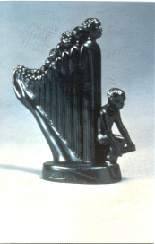
Sculpture: Lift Every Voice and Sing by August Savage, 1939
The Imperfect Model Minority
June 11, 2010
Driven by sustained immigration and refugee resettlement during the 1970’s and 1980’s, Asian Americans have emerged as the fastest growing racial group and labeled as the model minority. The label ballooned into a myth. Statistics are often cited to back up their model minority status such as high educational achievement, overrepresentation at Ivy League and other prestigious universities, and a high percentage of Asian Americans working in white collar professions (jobs such as medicine, investment banking, management consulting, finance, engineering, and law).
The term “model minority” was coined in the mid-1960s by William Petersen to describe Asians in comparison to African-Americans. Asian Americans were chosen as an example of a minority group who could succeed by “merit” alone without “affirmative action.” This assumption ignored completely each group’s American history and cultural mores. The first Asians came here as willing workers. Blacks were here dragged in chains.
Modelminority.com writes: “While superficially complimentary to Asian Americans, the real purpose and effect of this portrayal is to celebrate the status quo in race relations. First, by over-emphasizing Asian American success, it de-emphasizes the problems Asian Americans continue to face from racial discrimination in all areas of public and private life. Second, by misrepresenting Asian American success as proof that the US provides equal opportunities for those who conform and work hard, it excuses US society from careful scrutiny on issues of race in general, and on the persistence of racism against Asian Americans in particular.”
The problems of Asian Americans facing racism are detailed in Rosalind S. Chou and Joe R. Feagin’s book The Myth of the Model Minority. They too suffer from poverty, unemployment, discrimination and attendant mental health issues. Psychiatrists have long linked mental health and racial discrimination. Cho Seung-Hui’s 2007 Virginia Tech Massacre illustrates how the problems of Asian Americans can go undetected and untreated. Racism and discrimination are stressful events that adversely affect health and mental health. They place minorities at risk for mental disorders such as depression and anxiety.
In their important book Black Rage, psychiatrists Grier and Cobbs draw from records of patients to show that many psychological problems of African Americans are the result not only present-day discrimination but also of the accumulating impact of years of past discrimination. As they note, “a few black people may hide their scars, [but] most harbor the wounds of yesterday.” One advantage that African Americans have over many other Americans of color is many generations of building up a collective knowledge of white racism and of the strategies that enable people to resist it. In contrast, the collective memory of resistance strategies among Asian Americans seems relatively weaker and generally less effective in providing significant protection. (Chou and Feagin)
It’s not a perfect world and one can ill afford to ignore or underestimate the consequences of racism and discrimination as experienced by people of color.