
The Price of Passion: A Review of The Agitator’s Daughter
July 29, 2011
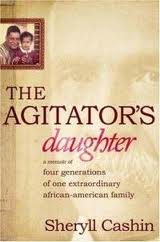 John Cashin’s death in March has renewed interest in Sheryll Cashin’s 2008 memoir The Agitator’s Daughter. It is the story of her father’s political fortune, his rise and fall and the price of passion as told by a precocious daughter coming of age in Huntsville Alabama during the height of the civil rights movement. She shares how family wealth dissipated with the moderate success of John Cashin’s political commitment. In the early 70s as a student at Fisk University I had the opportunity to hear Dr. Cashin speak. At the time uninterested in his subject, politics, I remember being struck by his energy. He had an almost larger than life presence, confident, boastful and driven. Sheryll Cashin’s story bears out this impression.
John Cashin and brother, Herschel, during their Omega partying days at Fisk made a pledge to continue the work of their great grandfather Herschel V. Cashin a radical Republican legislator in Reconstruction Alabama. The legislator’s political career like most African American office holders ended with Reconstruction and the disenfranchisement of African Americans sweeping the South. Brother Herschel studied law unable to earn a living in Alabama when the State enacted Jim Crow legislation depriving those studying out of state the right to practice leaving John Cashin alone to fulfill their fraternal pledge.
John Cashin became a dentist joining his father in a successful Huntsville Alabama practice. After military service and a tour in France he would return home to finish grand father Herschel’s work founding the National Democratic Party of Alabama in 1968. The Party became a prominent voice for Black voting rights and an important player in local politics in Black-dominated communities. It began the process of dismantling the segregationist chokehold on Alabama’s political process.
The Party in the name of Black voting rights would enjoy successes and suffer defeats until its demise in 1976 at a time when John Cashin’s reversal of fortune and personal calamities would mount. Sheryll Cashin laments the price her father paid for his commitment. A bitterness evolves to acceptance enabling the Georgetown law professor to no less carry on a family tradition of service and good works. Her memoir is an inspiring historical account delving into morality and the price of passion.
Sanford Roan’s First Round for Diversity
May 7, 2010
In 1939 Sanford Roan made several attempts to integrate the Ohio Highway Patrol. The first African-American applicant brought superior credentials, a graduate of North Carolina A&T with a business degree. He was a star athlete and later a trained pilot with military service. John Bricker an ambitious Ohio gubernatorial candidate urged Roan’s application suggesting the State was eager for an African American patrolman. In a ploy to capture the Black vote Roan unwittingly became a political pawn in Bricker’s election bid.
Ostracized throughout cadet training Roan coped with the humiliating and hostile environment as he would later express to President Roosevelt: “The boys when they would talk to me would make sure no one else was around to see them. Generally, they expressed their sympathy at the conditions, but said there was nothing they could do. I began to realize then that a business or an organization could only be as good as the person or persons controlling them.”
A popular athlete Roan attended a racially mixed high school. Graduating from college into the world of work his race made him a social outcast. Fed up with the treatment he quit the academy. Bricker promptly summoned him and with promises of support and assurances of being in his corner, Roan was persuaded to return. But thing’s grew worse, and again he quit. By then Roan’s difficulties became front page fodder closely followed by Ohio voters. Again in his persuasion this time Bricker promised a political appointment if Roan would only return until after the election. All the while Bricker’s cohort, the Ohio Highway Patrol department’s founder Colonel Lynn Black was determined to keep the force all white and set out to block Roan’s appointment. With a wink and nod from Colonel Black the “Jim Crow” treatment grew more intense. In what was to be routine sparring Roan stepped into a boxing ring surprised in the opposite corner as five white cadets filed in.
Bandaged and brutally beaten Roan submitted his final resignation. The sitting democratic Governor Martin L. Davey promised if re-elected to fire Colonel Black. Bricker promised an investigation. Both candidates only intended to energize the Black vote. Bricker won but his promise for change, an investigation, and a political appointment were quickly forgotten. Roan’s ambition of being a highway patrolman faded.
Bricker too in his ambition would also suffer defeat. The Republican nominee for Vice President of the United States in 1944 shared the unsuccessful ticket with Presidential nominee Thomas Dewey losing to Franklin Roosevelt. Roan might have found some solace in Bricker’s defeat but then Bricker served out his public life in the U.S. Senate. Sanford Roan, the father of Kay and Gary, went on to become a successful businessman in Columbus Ohio.
Sanford Roan was one of those rare men, a courageous pioneer who cleared a path for others. Because of men like Roan who stepped up to a challenge the struggle is no longer about fisticuffs, but continues in the greater goal for diversity. Local Human Rights Commissions now work side-by-side with police departments to overcome past wounds and to open new dialogue towards an inclusive future for all our citizens. Police forces now actively recruit from HBCUs. Sanford Roan’s story clearly illustrates the difficulties of getting to this point.