Mysticism in Latino Writing
November 20, 2011

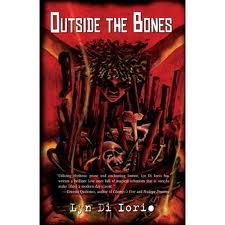
The MLK Library presented a Saturday afternoon book discussion on Mysticism in Latino Writing featuring authors Lyn Di Iori and Dahlma Llanos Figeroa. The authors discussed the role of mysticism in their novels. Lyn Di Iori’s Outside the Bones and Dahlma Llanos-Figueroa’s Daughters of the Stone are both receiving rave reviews. Iori’s Outside the Bones is an erotically charged ghost story set in both present-day New York and Puerto Rico. Praised as her brilliant debut novel it takes a mesmerizing look at issues of race, class, power and greed with Afro-Caribbean witchcraft rituals deftly woven through a sixteen year mystery unraveling a woman’s disappearance.
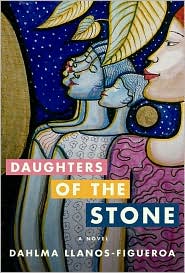
 Figueroa’s Daughters of the Stone follows a sacred stone handed down five generations used to invoke mystical powers and rituals of the old ones. A rich sensual tale of mothers and daughters, love and sorrow, hardship and pride the novel through conjuring up the spirits renders a magical, deeply real, and vividly told story surrounding diasporic people.
Both authors of Puerto Rican descent have chosen to raise the voice of the American Latina, half of the nation’s largest growing ethnicity, a segment of our culture not often heard. The powers of the Santeria, a religious practice with its African origins and Catholic influences and Puerto Rican spiritualism lie at the heart of both novels. Highly talented both authors continue a renaissance of award winning Latina writers exposing an American experience so long overlooked.
It has been said “Latina writers are powerful and seductive in their works. Their writings encompass the feelings women have in different situations, from dealing with a male-dominated society to family relationships.” No doubt the same can be said of the works of Iori and Dahlma. After readings the discussion ended with the interested patrons peppering the authors with questions about their themes, writing habits, and the Puerto Rican experience.
MLK Librarian Kathy Jenkins ended the program enthusiastically promising future similar author events. MLK Library and MahoganyBooks partnered in producing the program with the support of More Than Words (www.morethanwordsliterary.com) and Go On Girl! Book Club and Las Comadres.
Pamela Samuels Young
March 24, 2011

Murder on the Down Low opens at the funeral of Maya Washington. Mourning are her close knit girlfriends. Maya died of AIDS infected by her down low fiancé, Eugene Nelson. Her cousin Special Moore full of vengeful grief makes a scene vowing to make Eugene pay. Among this circle of girlfriends are two attorneys and a detective each with their own work place challenges. Special with the group’s help persuades Maya’s mother to bring a wrongful death action against Eugene. Meanwhile a serial killer is targeting down low professional African American men. Special in her uncontrollable grief mounts a campaign of harassment stalking Eugene. The wrongful death suit takes a turn for the worst when Special is charged as the suspected serial killer against a mountain of circumstantial evidence. Attorney Vernetta Henderson takes the lead as the girlfriends set out to prove Special’s innocence.
Anyone who enjoys the company of sophisticated ladies will love Vernetta Henderson and her crowd. Pamela Samuels Young sketches various recognizable female personalities and their friendships while painting a faithful portrayal of the men who love them. The author has mastered the fictional technique of raising the stakes with unexpected plot twist and turns. In this moral story of tolerance and understanding a seemingly unrelated series of events keeps the reader wondering on the edge of their seat while the author mixes up a mystery package tying it all together in a neat little bow like denouement.
Young self-published her first novel Every Reasonable Doubt establishing her own imprint. She told me she self-published her first novel hoping to be picked up by a major publishing house. Three block buster Essence Best Sellers later, that is no longer of interest. Who needs the powerhouse publisher or agent? Certainly not this author, Pamela Samuels Young is proving to be a self-publishing force.
Editors, publishers, and agents, the industry shakers and movers, the gate keepers sometime get it wrong ignoring certain talent and marketability as often the case with African American fiction writers who resort to self-publishing. We saw it with Omar Tyree, E. Lynn Harris, Mary Morrison and others time and again. Young is the latest in a long line of African American writers going against established industry trends. Thanks to the Internet writers like Pamela Samuels Young rise to success no longer limited by the subjective taste of a small few.
Examining the Tea Party
October 28, 2010
The NAACP in collaboration with the Institute for Research & Education on Human Rights recently released its report exposing the Tea Party, its racism, antisemitism, xenophobia, islamophobia, nativism and its militia impulse. The various Tea Party factions (Freedom Works Tea Party, Tea Party Nation, 1776 Tea Party, ResistNet Tea Party, Tea Party Patriots, and The Tea Party Express) all make up an umbrella of spoke like organizations serving as radial limbs. At its core the central shaft comprises disaffected white leaders espousing racist ideas and advocating violence and many of whom are formally associated with white supremacist organizations. This well researched documented report is a sobering read.
The Tea Party is not a political party rather a movement that emerged through a series of locally and nationally coordinated protests in response to several Federal laws: the Emergency Economic Stabilization Act of 2008, the American Recovery and Reinvestment Act of 2009, and the health care reform bill. The movement’s primary concerns, leaders of the movement claim, are cutting back on the size of government, lowering taxes, reducing wasteful spending, and reducing the national debt and federal budget deficit.
“Take America Back” is the Tea Party mantra directed at the African American President and clearly meant to address the nation’s growing population of people of color: Latinos, Asians, and African Americans. Essence Magazine reveals what is meant in an article written by Gini Sikes, a white journalist, who was hired to go undercover and report on the 2010 convention of the Council of Conservative Citizens who kept their meetings secret from the media. “As a White journalist hired by Essence to tell this story, I’m able to mingle with them,” wrote Sikes. “I discovered they have widely varying agendas, but two things clearly unite the majority: unyielding loyalty to their race and a hatred for President Obama.”
The leaders have a hidden unspeakable agenda with goals directed toward the social realm. The movement claims not to be Republican, but embraces Republican political philosophy to which opportunistic Republicans attempted to control, advising Tea baggers to disrupt and essentially break up town-hall meetings. This attempt at capturing and channeling this new found energy, seems to have failed with the rise of little known Tea party candidates, Sharon Angle, Joe Miller, Christine O’Donnell and Rand Paul, upsetting the establishment in race after race only to later stumble because of their inexperience is delivering their extreme message and dealing with the media.
The Tea Party is like an escaped circus chimp reeking havoc and danger on to all around. The question is will the American electorate wise up and push back on this extremist movement? Voting is the only way to sedate the creature and put it back in its cage.
A Good Day
June 25, 2010
Sunday past was Fathers Day. Unlike many others my father is still with us and we’re still building memories. I’d like to share this one: 1956 I was five years old. The family piled into the car on a Sunday drive from Gum Springs into the District of Columbia to visit my maternal great grandparents. A pony ride operated at the intersection of Richmond Highway and Fort Hunt Road. Little kids were lined up giddy with anxious excitement. The idea of taking his three kids on a pony ride delighted my father, and he asked if we wanted to. My brother and sister spoke up willingly. I had reservations. My father parked and along with my mother we waited in the car and watched him approach the attendant. Moments later he returned and started the car. My mother asked what happened. He responded, the man said they didn’t allow niggers to ride their ponies. We drove off everyone in silent wonderment. I can’t tell you how relieved I was at not being mounted on a beast and paraded about the smelly stable grounds. Though I had a cowboy outfit, I never wanted to be a cowboy. Like I said, it was a good day to be a nigger –for me at least–not so for my father. Can you imagine the indignities our forefathers endured?
Stony the road we trod,
Bitter the chastening rod,
Felt in the days when hope unborn had died;
Yet with a steady beat,
Have not our weary feet
Come to the place for which our fathers sighed?
We have come over a way that with tears has been watered,
We have come, treading our path through the blood of the slaughtered,
Out from the gloomy past,
‘Til now we stand at last
Where the white gleam of our bright star is cast.
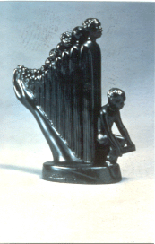
Sculpture: Lift Every Voice and Sing by August Savage, 1939
Me Nigger Too
May 29, 2010
In Kingston’s Norman Manley International Airport I spotted a group of twenty something dudes–or is it dawgs–dressed in that distinctive urban hip hop style– baggy slacks oversized shirts and baseball caps decidedly cocked or worn backwards. Ordinarily I wouldn’t have given much attention except all were of Chinese descent. They could have been Jamaicans or from the States, San Francisco, New York even London or Beijing.
They were reminders of an incident in DC during the ’68 riots following Martin Luther King’s assassination. In the inner city inferno a fearful Chinese laundry proprietor placed a scribbled sign in his window pleading No Burn–Me Nigger Too. However inartful his language it was nevertheless a striking acknowledgement of our common humanity. African and Chinese first coming to America albeit under different circumstances shared a common experience facing the same hostile forces.
By the 1950’s and the advent of the Civil Rights movements the Chinese had achieved a tenuous integration throughout the South. Too few to be regarded as a threat most owned their own businesses as grocers and shopkeepers relying on black customers and accommodating white neighbors. It wasn’t until the 1960s after more than a century of racial injustice would they find their voice challenging the system. Two American born Chinese, Grace Lee Boggs and Fred Ho, activists and writers both in their work borrowed heavily on the African American experience demonstrating, protesting, marching, and speaking out.
Grace Lee Boggs the daughter of Chinese immigrants educated at Barnard College receiving a Ph.D from Bryn Mawr in 1940 worked with West Indian Marxist historian C.L.R. James using the pen name Ria Stone. In 1953, she moved to Detroit where she married James Boggs, an African-American labor activist, writer and strategist. The two worked together in grass roots groups and projects for 40 years until Boggs’ death in July 1993. Their book, Revolution and Evolution in the Twentieth Century was published in 1974.
American jazz baritone saxophonist, Fed Ho is also a composer, bandleader, playwright, writer and social activist though most often identified with the Asian American jazz or avant-garde jazz movements. Many of his works fuse the melodies of indigenous and traditional Asian and African music. The first to combine Chinese operas and African American music he is a prolific composer and writer with a third book in progress about African Americans and Asians working together in civil rights.
There is a common thread of oppression discrimination and violence against African and Chinese Americans throughout American history. The word Nigger has come to symbolize that inhumanity. As Langston Hughes declared I Too Sing America, and no doubt Americans Grace Lee Boggs and Fred Ho wouldn’t hesitate to claim Me Nigger Too.
As part of Asian Pacific American Heritage month this is the 2nd of a four part series.