A Good Day
June 25, 2010
Sunday past was Fathers Day. Unlike many others my father is still with us and we’re still building memories. I’d like to share this one: 1956 I was five years old. The family piled into the car on a Sunday drive from Gum Springs into the District of Columbia to visit my maternal great grandparents. A pony ride operated at the intersection of Richmond Highway and Fort Hunt Road. Little kids were lined up giddy with anxious excitement. The idea of taking his three kids on a pony ride delighted my father, and he asked if we wanted to. My brother and sister spoke up willingly. I had reservations. My father parked and along with my mother we waited in the car and watched him approach the attendant. Moments later he returned and started the car. My mother asked what happened. He responded, the man said they didn’t allow niggers to ride their ponies. We drove off everyone in silent wonderment. I can’t tell you how relieved I was at not being mounted on a beast and paraded about the smelly stable grounds. Though I had a cowboy outfit, I never wanted to be a cowboy. Like I said, it was a good day to be a nigger –for me at least–not so for my father. Can you imagine the indignities our forefathers endured?
Stony the road we trod,
Bitter the chastening rod,
Felt in the days when hope unborn had died;
Yet with a steady beat,
Have not our weary feet
Come to the place for which our fathers sighed?
We have come over a way that with tears has been watered,
We have come, treading our path through the blood of the slaughtered,
Out from the gloomy past,
‘Til now we stand at last
Where the white gleam of our bright star is cast.
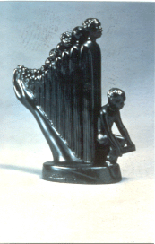
Sculpture: Lift Every Voice and Sing by August Savage, 1939
A Washington Tradition Back to Segregation
April 5, 2010
Last week Eugene Allen died at age 90. The White House butler for 8 presidents from 1952 to 1986 started out as a “pantry man” and dishwasher moving up to Maitre d’. Allen probably took to his grave a host of inside stories of White House goin’ ons, juicey tidbits whispered in confidence among the colored help. No doubt Allen was often an active planner and participant in a White House tradition taking place today, the Easter Egg Roll, the biggest annual White House gathering. He was there when Mamie Eisenhower decided it was time to desegregate the event.
African American children were not allowed inside the White House gates, a tradition dating back to 1878 when Rutherford B. Hayes– the same President who ended Reconstruction–hosted the first White House Easter Egg Roll. Occurring on Easter Sunday a workday for most of Washington’s Black servants who even if possible couldn’t afford to take off and chaperon their children to the public event. Two years later the Smithsonian began what became another tradition believed to be a direct response to the White House practice making African-American children persona non grata.
To this day on Easter Monday D.C.’s children of color still gather at the Smithsonian National Zoo where “ice cream, food and Easter egg hunts await them.” As a child growing up here I remember Washington as a largely segregated city in the 1950s. Like Eugene Allen I’ve seen much change. African Americans coming and going through White House gates are a common occurrence–only now their presence is no longer restricted to the back of the house.