Fashion’s Lack of Diversity
June 19, 2010
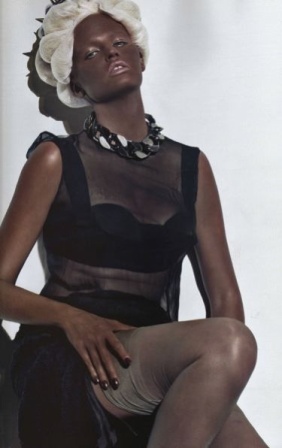
The lack of minority input was apparent when French Vogue’s October cover sported a white model in blackface—and to add insult to injury the entire magazine layout failed to include a single non-white model. At a time of the declining print media this was Vogue’s mad attempt to grab publicity and sell magazines regardless of political correctness. This sort of in your face racism is generally expected from the French.
In the U.S. the same disregard was aired on Project Runway when Emile Sosa a Black Dominican born New Yorker won weekly competition after competition only to lose the coveted grand prize to the lack luster performance of Seth Aaron Henderson, a white male. The reason given was that Sosa produced a line while Henderson produced a collection. If I understand the difference correctly, a collection is a designer’s creation for a single season meant to be more edgy and artistic while a line reflects a longer lasting commercial appeal. I thought it was about whoever produced the best work of redeeming quality. Reviewing past competitions evidence suggests line vs. collection became a new standard. Rather than give the Black designer the award the all white judges simply moved the goal post.
As for the dearth of diversity in print, Fashion editors claim their backs are against the wall, with their magazine’s sole income dependent on advertisers their decisions are based on advertiser preferences. It’s all business nothing personal or racist. The fear of low sales and advertisers pulling back prevents editors from putting dark-skinned models or celebrities on the covers of fashion/women’s magazines (which are mostly Caucasian owned). When ethnic consumers quit patronizing these advertisers then what? This same specious argument was used by Southern businessmen to oppose integration during the civil rights movement. Hindsight has shown by opening the doors of opportunity and embracing all, it enhances a business’s goodwill as well as its bottom line.
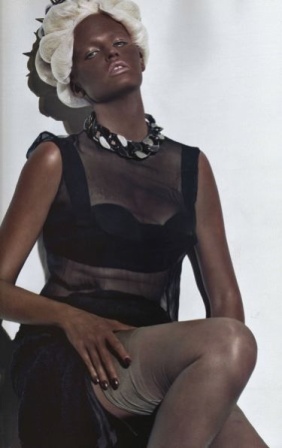
It all comes down to the personal taste of editors who wield an awful lot of power in the industry (remember the Devil Wears Prada). Now is the time for consumers to exercise their power. If fashion’s print media is to thrive and reverse the decline in readership it needs to become more relevant and by that more inclusive. It can only do so by recruiting more minority editors and writers, Blacks, Latinos, and Asians who are as acutely aware of their own ethnic aesthetic as they are the Anglo-American.
And minority consumers can make their preference known by insisting that industry giants the likes of Vogue, Marie Claire, Elle, Bazaar and Glamour begin to recruit minority editors and writers. Consumers can further demand the Council of Fashion Designers in American become more accountable and step up its efforts to bring diversity to the industry. A minority presence would put an end to stunts like Vogue’s black face.
The Imperfect Model Minority
June 11, 2010
Driven by sustained immigration and refugee resettlement during the 1970’s and 1980’s, Asian Americans have emerged as the fastest growing racial group and labeled as the model minority. The label ballooned into a myth. Statistics are often cited to back up their model minority status such as high educational achievement, overrepresentation at Ivy League and other prestigious universities, and a high percentage of Asian Americans working in white collar professions (jobs such as medicine, investment banking, management consulting, finance, engineering, and law).
The term “model minority” was coined in the mid-1960s by William Petersen to describe Asians in comparison to African-Americans. Asian Americans were chosen as an example of a minority group who could succeed by “merit” alone without “affirmative action.” This assumption ignored completely each group’s American history and cultural mores. The first Asians came here as willing workers. Blacks were here dragged in chains.
Modelminority.com writes: “While superficially complimentary to Asian Americans, the real purpose and effect of this portrayal is to celebrate the status quo in race relations. First, by over-emphasizing Asian American success, it de-emphasizes the problems Asian Americans continue to face from racial discrimination in all areas of public and private life. Second, by misrepresenting Asian American success as proof that the US provides equal opportunities for those who conform and work hard, it excuses US society from careful scrutiny on issues of race in general, and on the persistence of racism against Asian Americans in particular.”
The problems of Asian Americans facing racism are detailed in Rosalind S. Chou and Joe R. Feagin’s book The Myth of the Model Minority. They too suffer from poverty, unemployment, discrimination and attendant mental health issues. Psychiatrists have long linked mental health and racial discrimination. Cho Seung-Hui’s 2007 Virginia Tech Massacre illustrates how the problems of Asian Americans can go undetected and untreated. Racism and discrimination are stressful events that adversely affect health and mental health. They place minorities at risk for mental disorders such as depression and anxiety.
In their important book Black Rage, psychiatrists Grier and Cobbs draw from records of patients to show that many psychological problems of African Americans are the result not only present-day discrimination but also of the accumulating impact of years of past discrimination. As they note, “a few black people may hide their scars, [but] most harbor the wounds of yesterday.” One advantage that African Americans have over many other Americans of color is many generations of building up a collective knowledge of white racism and of the strategies that enable people to resist it. In contrast, the collective memory of resistance strategies among Asian Americans seems relatively weaker and generally less effective in providing significant protection. (Chou and Feagin)
It’s not a perfect world and one can ill afford to ignore or underestimate the consequences of racism and discrimination as experienced by people of color.
Black Lives Have Less Value
June 9, 2010
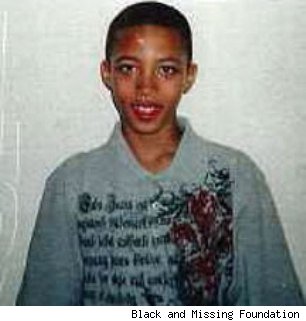 Anthony Thomas and Kyron Horman: Two Missing Boys Demonstrate Disparity in Coverage
It’s sad and unfortunate that two boys suddenly vanish without a trace. We ask ourselves a great many questions like who would do such a thing and why. Then there is the question why are greater resources brought to bear in the search for one over the other. Unfortunately, these are editorial decisions that reflect editorial values over community values. The unmistakable conclusion, Kyron Horman is white and has garnered national media attention while Anthony Thomas is black and has received neither local nor national media attention and that black life has less value.
Remembering Vincent Chin
June 7, 2010
Twenty eight years ago this month a hate crime galvanized the Asian American community. The killing of Vincent Chin and the subsequent trial of his killers heightened the awareness of discrimination and racism directed toward the Asian Pacific community. Chinese American Vincent Chin was having his bachelor party in a Detroit bar. Thinking he was Japanese two white who had recently been laid from Chrysler started a fight and beat Chinese several time with a bat leaving him brain dead. He died four days later. The judged fined the defendants $3,000 and ordered them to pay $780 in court fees.
At the time–and not unlike today–Michigan and its automotive industry were in a severe downturn. Ronald Ebens and Michael Nitz were involved in an altercation at the Fancy Pants in Highland Park where Vincent Chin was with three of his friends celebrating his bachelor party. During the altercation, Ebens reportedly said “because of you m—– f——, we’re out of work.” After both Ebens and Nitz, and Chin and his friends were bounced out of the Fancy Pants, Ebens and Nitz pursued Vincent Chin and his friend Jimmy Choi. They enlisted Jimmy Perry to find the “Chinese guys,” and caught up to Vincent on Woodward Avenue in front of McDonald’s Restaurant. While Nitz held Chin, Ebens beat Chin with a baseball bat. Two off-duty Highland Park Police officers saw the beating. Vincent Chin died on June 23, 1982 when he was disconnected from life support.
The Michigan Judge didn’t place much value on an Asian man’s life. The ruling seemed a throwback when Chinese, like Blacks and Indians, were not allowed to testify against whites in court. The case became a rallying point for the Detroit community, Journalist Helen Zia and lawyer Lisa Cheuk May Chin led the fight for federal Civil Rights charges. Only one of the accused was convicted and his charges were later overturned on appeal. However, a civil suit was brought on behalf of Chin’s mother awarding her a $1.5 million judgment which she has since had difficulty enforcing.
The case became a defining moment for civil rights advocacy in Asian Pacific American communities from coast to coast and helped spawn a number of Asian Pacific American organizations devoted to tracking and investigating hate crimes, including Asian American Citizens for Justice, the Committee Against Anti-Asian Violence in New York, the national Network Silence Coalition Against Anti-Asian Violence in San Francisco.
During times of economic distress immigrants often become targets of a few of the irrational majority. Today it’s common to read about hate crimes committed against minorities and Latino immigrants in particular. Vincent Chin should not be remembered just by the Asian community, but by all Americans. Vincent Chin’s death is a call to support all local and federal hate crimes legislation.
Me Nigger Too
May 29, 2010
In Kingston’s Norman Manley International Airport I spotted a group of twenty something dudes–or is it dawgs–dressed in that distinctive urban hip hop style– baggy slacks oversized shirts and baseball caps decidedly cocked or worn backwards. Ordinarily I wouldn’t have given much attention except all were of Chinese descent. They could have been Jamaicans or from the States, San Francisco, New York even London or Beijing.
They were reminders of an incident in DC during the ’68 riots following Martin Luther King’s assassination. In the inner city inferno a fearful Chinese laundry proprietor placed a scribbled sign in his window pleading No Burn–Me Nigger Too. However inartful his language it was nevertheless a striking acknowledgement of our common humanity. African and Chinese first coming to America albeit under different circumstances shared a common experience facing the same hostile forces.
By the 1950’s and the advent of the Civil Rights movements the Chinese had achieved a tenuous integration throughout the South. Too few to be regarded as a threat most owned their own businesses as grocers and shopkeepers relying on black customers and accommodating white neighbors. It wasn’t until the 1960s after more than a century of racial injustice would they find their voice challenging the system. Two American born Chinese, Grace Lee Boggs and Fred Ho, activists and writers both in their work borrowed heavily on the African American experience demonstrating, protesting, marching, and speaking out.
Grace Lee Boggs the daughter of Chinese immigrants educated at Barnard College receiving a Ph.D from Bryn Mawr in 1940 worked with West Indian Marxist historian C.L.R. James using the pen name Ria Stone. In 1953, she moved to Detroit where she married James Boggs, an African-American labor activist, writer and strategist. The two worked together in grass roots groups and projects for 40 years until Boggs’ death in July 1993. Their book, Revolution and Evolution in the Twentieth Century was published in 1974.
American jazz baritone saxophonist, Fed Ho is also a composer, bandleader, playwright, writer and social activist though most often identified with the Asian American jazz or avant-garde jazz movements. Many of his works fuse the melodies of indigenous and traditional Asian and African music. The first to combine Chinese operas and African American music he is a prolific composer and writer with a third book in progress about African Americans and Asians working together in civil rights.
There is a common thread of oppression discrimination and violence against African and Chinese Americans throughout American history. The word Nigger has come to symbolize that inhumanity. As Langston Hughes declared I Too Sing America, and no doubt Americans Grace Lee Boggs and Fred Ho wouldn’t hesitate to claim Me Nigger Too.
As part of Asian Pacific American Heritage month this is the 2nd of a four part series.