Night Hawk an historical romance of substance
July 21, 2012
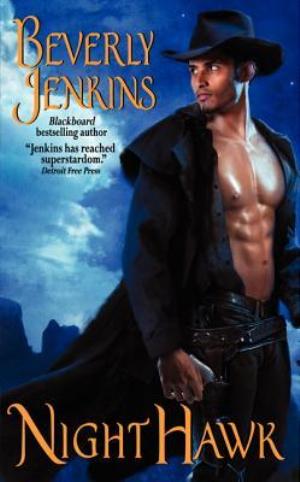 Beverly Jenkins’ Night Hawk is so evocative of deep emotions it seems she’s elevated the historical romance to a high art enhancing our understanding of American life during the 19th Century. Through her effective didactic story telling she immerses the reader back to another time. While the African American heritage primarily flows from the Middle Passage there are other neglected streams Jenkins mines like a gold panning prospector. She offers up a tale threading rich historical nuggets reflecting dark times of struggle and racial strife. People of color much like the larger society immigrated to the American shores from foreign lands in search of freedom and fortune and therein thrived despite racially sanctioned legal limitations.
So goes the story of Ian Vance Bigelow, a Scotsman and son of a Black man, and the equally compelling story of Maggie Freeman, the daughter of a Native American Kaw and a Black man. The spark of their romance and the light of their love make the vicarious experience of their journey worth following.
Night Hawk begins in 1889 two continents apart with Ian Vance Bigelow aka Preacher the gun toting bounty hunter turned U.S. Marshall returning to his homeland Scotland to visit his mother’s grave and there confronts his mother’s father. The wealthy grandfather delivers the mother’s dowry–festering guilt money. On Ian’s return journey traveling from Boston to his ranch in Wyoming by train and horse he finds himself burdened with escorting a prisoner. On a train stop in Dowd Kansas his path intersects with Maggie Freeman. Maggie, orphaned at an early age has been forced to eke out a living. In an attempted rape while working as a cook in a cat house she defends herself resulting in her attacker’s accidental death. Under arrest and to avoid a lynch mob the Sheriff attempts to move his prisoner to Kansas City when circumstances forced him to turn Maggie over to the U.S. Marshall, Ian Vance Bigelow, for delivery. From thereon to Cheyenne in a series of episodic adventures the two must overcome a series of obstacles including a budding romance.
Jenkins embeds accurate historical facts based on the established roots of real people into her stories paying homage to the diverse roots of the American people. Her lead characters are heroic, courageous, and far from stereotypical. exploring the struggles of African-Americans, Chinese-Americans, and Native Americans. The couples’ journey is skillfully woven with remarkable fidelity into the American historical tapestry. With some 30 books the award winning romance novelist Beverly Jenkins ranks among best, but as for the specific African American historical romance she is a pioneer at the absolute top, and with her vivid characters, intense love scenes and substantive themes it easy to see how she got there.
Book Review: Image of Emeralds and Chocolate
July 12, 2012
 K. Murray Johnson’s first novel Image of Emeralds and Chocolate is a mixture of voodoo, vampires, and pure hokum. I’m not sure how much suspension of disbelief is required to enjoy a good vampire story, but then again I’m not into paranormal or any type of science fiction literature. I’m more of a realist and that’s how I like my fiction. That being said I approached Image of Emeralds in Chocolate with an open mind purely for its entertainment value. I admit my bias for realism shows. In the end I closed the book thoroughly entertained though a little frustrated. Vampire stories are all the rage these days and K. Murray Johnson is riding the wave with his gay slave turned abolitionist vampire tale.
This novel weaves together the stories of two men and their love for one another, one born into slavery and the other coming of age in modern times. They meet as students in a creative writing class and are assigned as writing partners who must share and critique the other’s work. The former slave Emanuel writes a series short stories while the younger Eric delves into poetry. Eric is a talented competitive musician, his life’s preoccupation, but his goals are thwarted by evil competition. This drama plays out over a semester and it is Emanuel who rids the evil and in so doing reveals his secret biography through a series of short stories.
It starts off slow but pressing through to the midway point the reader gets swept up in the story. It becomes an historical saga seen through the eyes of a vampire and therein lies the frustration. Suspension of disbelief is challenge enough but the lack of historical accuracy was a distraction that at times made it impossible. Some might consider it minor, but slaves didn’t clean bathrooms when the bathroom was more likely than not a privy. Nor did the plantation house have attached kitchens. Anyone who has ever toured an 18th Century plantation or homestead knows that kitchens were detached because they were prone to fires. Call me a stickler about historical accuracy but Johnson could have benefited from more conscientious research.
Gay vampire erotica is nothing new and K. Murray Johnson should be commended for paving the way for Black writers and readers interested in this genre. Images of Emeralds and Chocolate is an entertaining and interesting read but it lacks a certain fidelity which could have made it much better. The dialogue at times comes off as stilted and contrived and the story bogs down in places. Nevertheless the protagonist Emanuel the legendary vampire is a compelling and attractive creature with a certain appeal leaving readers saying “Ah man, bite me.” 4 Stars
Health Care Reform saved by The Magnificent Yankee
June 29, 2012
 I’m no legal scholar, but correctly predicted the Supreme Court would uphold the Patient Protection and Affordable Care Act. That prediction was based on my understanding of stare decisis, the obligation of the courts to honor past precedents. Out of curiosity and for my own edification I read the relevant case history supporting the Commerce Clause arguments. While the government’s reliance on the Commerce Clause struck me as weak and in fact was struck down by the Court I wondered why they did not aggressively argue the Tax and Spending clause. As we all know there are only two things certain in life death and taxes, and the government’s power to tax is indisputable. The Tax and Spending Clause was used as a back up argument while the Commerce Clause argument seem to serve as a red herring.
The court was faced with a dichotomy determination and it was Justices Story and Holmes who provided the answer. Roberts writes:
“The text of a statute can sometimes have more than one possible meaning. To take a familiar example, a law that reads “no vehicles in the park” might, or might not, ban bicycles in the park. And it is well established that if a statute has two possible meanings, one of which violates the Constitution, courts should adopt the meaning that does not do so. Justice Story said that 180 years ago: “No court ought, unless the terms of an act rendered it unavoidable, to give a construction to it which should involve a violation, however unintentional, of the constitution.” Parsons v. Bedford, 3 Pet. 433, 448–449 (1830). Justice Holmes made the same point a century later: “[T]he rule is settled that as between two possible interpretations of a statute, by one of which it would be unconstitutional and by the other valid, our plain duty is to adopt that which will save the Act.” Blodgett v. Holden, 275 U. S. 142, 148 (1927) (concurring opinion).
The most straightforward reading of the mandate is that it commands individuals to purchase insurance.” National Federation Of Independent Business Et Al. V. Sebelius, Secretary Of Health And Human Services, Et Al. ___U.S. ___ (2012)
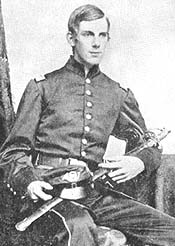
Justice Holmes by reaffirming Justice Story’s dictum provided the necessary constitutional basis to uphold the Health Care Reform Act. Justice Oliver Wendell Holmes Jr. served as on the Supreme Court from 1902-1932. The 1950 Academy Award winning movie The Magnificent Yankee introduced me to Justice Holmes long before I had any interest in law school. The Boston blue blood was a wounded Civil War veteran who saw a lot action. He bequeath his entire estate to the U.S. Treasury and wrote the dissenting opinion in the Lochner vs. New York, 198 U.S. 45 (1905), a landmark case that held a “liberty of contract” was implicit in the due process clause of the Fourteenth Amendment. Holmes accused the majority of judicial activism, pointedly claiming that the case was “decided upon an economic theory which a large part of the country does not entertain. He attacked the idea that the Fourteenth Amendment enshrined the liberty of contract, citing laws against Sunday trading and usury as “ancient examples” to the contrary. He added, “Some of these laws embody convictions or prejudices which judges are likely to share. Some may not. But a constitution is not intended to embody a particular economic theory.”
President Obama has likened the Lochner case to this instant case. Lochner was about limiting the collective bargaining rights of employees in favor of the employer. Roberts in this instant rather than trying to fashion conservative reasoning to overturn the independent mandate he stayed true to the legal doctrines and the fundamental principles of jurisprudence upon which American law is based. Though much credit will be given to Justice Roberts for his decision in upholding the Affordable Care Act he must share that credit with Justice Holmes and Justice Story for mapping the direction.
Thank You Justice Holmes and Justice Story.

The Intouchables becoming an international box office hit
June 9, 2012
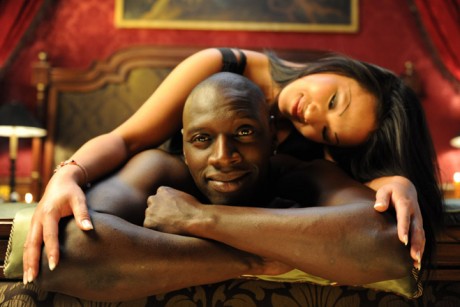 Since most Americans generally frown on foreign films particularly those with subtitles they will probably have to wait for the American remake of The Intouchables–the rights of which have been brought by The Weinstein Co. and probably now in the pipeline. Those who wait do so at a loss. The original is already the most watched film in France and quickly becoming an international box office hit having won the Tokyo International Film Festival best film award and the César Awards for best actor (the French equivalent to the American Oscar). Omar Sy is the first actor of African descent to receive a César for Best Actor. The Intouchables is 2012’s highest grossing move in a language other than English. That says much to those who have traveled abroad and seen how American films dominate foreign cinema.
The Intouchables is based on a true story about the developing bond between a quadriplegic paralyzed from the neck down and an ex-con Black man who reluctantly becomes his caretaker. The wealthy Philippe played by Francois Cluzet lives in a luxurious Parisian mansion. Driss just out of prison from a six month robbery sentence shows up among a line of applying experienced white caretakers. Driss is not there for the job but a for signature verifying that he applied, the signature evidencing he meets the requirements for state benefits. But Philippe is drawn to Driss’s magnetic unflappable rambunctious and unrefined personality luring him into taking the job. Driss fights it every step away finally submitting to the mansion’s comfort and riches. Philippe introduces him to fine art and classical music while Driss in return offers lessons in American music through the sounds of Kool and the Gang and Earth Wind and Fire.
The employment relationship survives a 30 day probationary period overcoming the stress test sealing a bond, but the tests don’t stop here. Driss sets out on a constant quest to seduce Philippe’s secretary while coping with Phillip spoiled brat daughter. Driss too has his own handicaps. His mother kicks out of the house and a not being there for a younger brother involved in drug activities takes its toll on family. Then Driss discovers Philippe has a purely epistolary relationship with a German woman named Elenore and attempts to bring the pen-pal lovers together. The employer and employee become buddies each instinctively knowing how to serve one another.
Driss’ comedic quick witted response to white French bourgeois culture provides much of the stories comedic fodder. And it is incredibly funny with great writing, great cinematography and a sublime soundtrack blending both European classical music and American R&B.
Without a doubt much of this film’s success is attributable to Omar Sy’s superb acting. A minor accomplished French television actor Omar Sy is skyrocketing across the international screen with his portrayal of Driss. Hollywood’s new sought after hot talent was born in France to a Mauritanian mother and Senegalese father. One of eight children he grew up in a housing project 20 miles west of central Paris. Out of the housing project Sy similarly shares much with his character Driss. As quoted in the The Los Angeles Times [h]e speaks knowingly of “two Frances”–the stratum of the country that is wealthy and has access to the arts and the largely immigrant working class that does not. “The thing about this movie,” he said proudly, “is that it brought them together. People from one France came to the theater not knowing anything about the other France and they left having learned a lot, having sat together and laughed at the same jokes.”
Variety critic Jay Weisberg wrote a searing review calling it racist describing Driss as a performing monkey and “jolly house slave of yore, entertaining the master while embodying all the usual stereotypes about class and race.” As a Black man daily experiencing the vestiges of slavery and global racism first hand I was nevertheless thoroughly entertained. To Weisberg I say lighten up and laugh quoting Victor Hugo Laughter is the sun that drives winter from the human face.
Jewell and The Dapper Dan
June 5, 2012
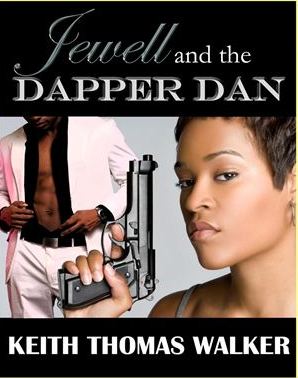 When I first encountered Keith Thomas Walker at the 2012 Romance Slam Jam I was curious about all the buzz surrounding him. Having now read only one of his 7 books with two more due out this year it’s all been made clear. Keith Thomas Walker is a rare writer with a remarkable talent. Jewell and The Dapper Dan could be described as a modern day Bonnie and Clyde with a Black ghetto twist. It’s a tale chocked with romantic intrigue and gripping suspense woven through a riveting plot. The titled characters Jewell and her Dapper Dan are so skillfully drawn they jump off the page. In a setting where violence is a matter of fact first response the in your face blatantly aggressive and provocative behavior is real and unsettling. With few admirable qualities the dynamic duo are exquisitely sensuous and titillating. Keith Thomas Walker has done an exceptional job creating real believable–even lovable–characters.
Jewell is a gangster moll with a conscience, compassion and empathy, but beware she can flip in a spilt second. She’s able to care for her ailing mother and won’t hesitate to smack a poorly performing nurse. Jewell’s attempt to aide her recovering addict brother by bringing him into the syndicate backfires doing him more harm than good. Her disdain for her overly pious sister devoted to her children and her near do well deacon-husband seems all too real. Jewell is at times loyal to a fault but a chameleon able to rise to just about any occasion assuming any role in any circumstance. Her striking good looks and figure cause men drunk with desire to fall prey and defenseless.
Dapper Dan is a hardened, cold focused and skilled criminal who regards himself as a genius. He rises from a pimp to an accomplished syndicate boss racking up one successful robbery after another all due to his brilliant planning. He plans a final job a huge diamond heist that will end his criminal career enabling the couple to settle down to a normal family life. Despite the obstacles and the gang’s resistance he pushes them forward undeterred with his eye on the prize believing in his own genius. But trust becomes an issue and who can you trust? Our gangsters prove the old adage there is no honor among thieves.
Dapper Dan’s blinded by greed and vanity leading his gang of thieves at a time when their allegiance is worn by his questionable judgment influenced by Jewell’s love. In the end the lesson is crime doesn’t pay–at least not for the crime boss. There are a host of minor characters the reader will find compelling particularly the furniture magnate Percy Hamilton and his gold digging houchies who prove no match for Jewell.
Keith Thomas Walker writes with a rare authenticity. Jewell and The Dapper Dan deserves nothing less than 5 stars.