A Review of Seduced by a Stallion by Deborah Fletch Mello
August 9, 2012
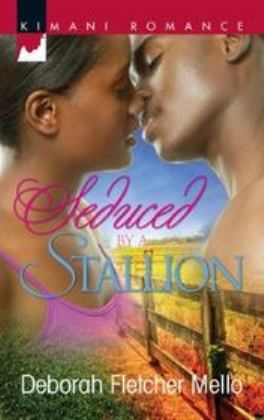 Romances are always fun to read because they are meant to entertain and satisfy. Those who enjoy vicariously experiencing the roller coaster emotions of falling in love will find satisfaction guaranteed in Deborah Fletcher Mello’s Seduced by a Stallion. Playboy Matthew Stallion the second oldest of the four billionaire Stallion brothers is a charismatic attorney, handsome and seemingly all too perfect especially in the eyes of Judge Katrina Broome a widowed mother. When her teenage son Collin steals and wrecks Matthew’s car the attorney agrees to mediation. Through Matthew’s negotiation Katrina agrees to place Collin in the Briscoe Ranch Mentoring Foundation program for at-risk youth of which Matthew sits on the Board. From that very first courtroom moment the couple’s mutual attraction is sparked and soon grows all consuming like an out of control wild fire.
Katrina in her mind attempts to dismiss her desires but her heart will not permit it. Matthew too copes with his own infatuation and so begins the slow rising romance with a first date, a private diner for two at Cowboy’s Stadium set at center field. “As they approached the center of the stadium, Katrina took in the immaculately set table …. adorned with an elegant white lace tablecloth, gold chargers, gold–trimmed china plates, gold utensil and crystal glasses. A tuxedoed waiter stood at attention.”
That over the top date pales compared to their Parisian excursion on the private Stallion jet. There in addition to their common profession they find their aesthetic sensibilities are in sync as well sharing their love for French Impressionism, Rodin and Camille Claudel. As wonderfully ideal and dreamy as it all seems, no romance is complete without conflict, and it comes in the form of Matthew’s “baby daddy drama” threatening to derail their happily ever after destiny.
Other titles in the series are (1) To Love A Stallion (John) (2) Tame A Stallion (Mark) (3) Lost In A Stallion (Luke) (4) Promises To A Stallion (Travis-a cousin). I understand there’s a Stallion sister waiting in the wings to make her debut.
I suspect there are many things the reader will find enjoyable with each brother’s romantic journey. Deborah Fletcher Mello’s major characters are all identifiably real and aching with desire. Her sublime language depicting intense love scenes may at times leave the reader breathless or at least forced to put it down to cool down. But be advised Seduced by a Stallion is a titillating tale you can’t put down for long.
Chocolate City’s gentrification and the trail of tears
August 5, 2012
Gentrification is destroying whole communities leaving lower income residents homeless and hopeless seemed to be Saturday’s message from the special screening of Chocolate City sponsored by Maximize Good at the Watha T. Daniel Public Library. A discussion with filmmaker Ellie Walton and DC residents followed. While the film was shot in 2003 almost a decade later the message is resonating with greater urgency. The documentary covers the displacement of over 400 families who lost their battle against forced displacement from the Arthur Capper/Carrollsburg public housing project in Washington, DC. Filmmaker Ellie Walton views Chocolate City as a call to action against nationwide gentrification and redevelopment programs. The film explores the impact of rapid gentrification in the area through the work of a local group of women working for justice in their neighborhood.
In 2001, DC received a $34.9 million Hope VI grant to redevelop the 23-acre Capper/Carrollsburg public housing project as a mixed-income community, with the 700 public housing units to be replaced one-for-one, along with 1,000-plus market-rate and workforce-rate rental and ownership units and 50 Section 8 ownership units. The project is scheduled to be completed this year.
The 400 displaced families were promised a one-to-one replacement of all demolished public housing units. That is, for every one family displaced they would be replaced with a unit in the new housing project. However residents later discovered lower income residents did not qualify. Income qualifications based on regional median income standard disqualified a majority of renters with few qualifying to buy. The average median household income inside the beltway is $90.
Hope VI requires mixed income residents meet an income threshold of 60% of the regional average median income. Many of the former residents were minimum wage earners and financially barred from returning. The reality is that mixed income does not include low income. The former residents soon found additional barriers to reentry including a vague rule that only residents in “good standing” would be allowed to return those without past felony convictions.
As the discussion progressed many spoke with concern about the unfairness of current policies with some telling of their own displacement. In the film examples were sited on how the loss of community and its support resulted in the death of older displaced residents. In the discussion a participant identified as Daniel born and raised in DC told of his being homeless and currently having wait listed 8 years for housing. Community activist Louise Thundercloud shared her personal fights with DC Council members characterizing the situation as “cultural genocide” and efforts by the moneyed establishment to destroy communities of color specifically Black and Latino.
One participant likened the situation to the West Bank Israeli settlements with the Palestinians being pushed off their homelands. The issue of affordable housing is not likely to go away. According to the Urban Institute the federal government provides housing assistance through rent subsidies, tax credits for building affordable housing, and block grants for affordable housing initiatives. But only about one of every four eligible households gets such aid. And subsidized housing is found disproportionately in distressed neighborhoods characterized by crime, poorly performing schools, and a lack of jobs.
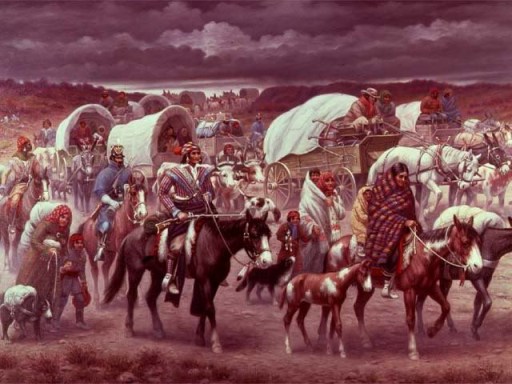
Low-income families are being forced out of their communities similar to the forced displacement of Native Americans in the 1830s. The history lesson remains the same. Misguided government policies are doing more harm than good and by inadequately addressing the problem only perpetuates the cycle and generations of inescapable poverty and disadvantage. Chocolate City as the filmmaker declares does indeed stand as a call to action.
Night Hawk an historical romance of substance
July 21, 2012
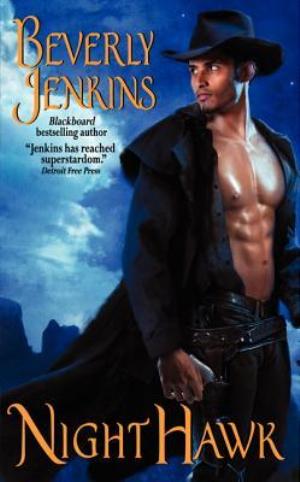 Beverly Jenkins’ Night Hawk is so evocative of deep emotions it seems she’s elevated the historical romance to a high art enhancing our understanding of American life during the 19th Century. Through her effective didactic story telling she immerses the reader back to another time. While the African American heritage primarily flows from the Middle Passage there are other neglected streams Jenkins mines like a gold panning prospector. She offers up a tale threading rich historical nuggets reflecting dark times of struggle and racial strife. People of color much like the larger society immigrated to the American shores from foreign lands in search of freedom and fortune and therein thrived despite racially sanctioned legal limitations.
So goes the story of Ian Vance Bigelow, a Scotsman and son of a Black man, and the equally compelling story of Maggie Freeman, the daughter of a Native American Kaw and a Black man. The spark of their romance and the light of their love make the vicarious experience of their journey worth following.
Night Hawk begins in 1889 two continents apart with Ian Vance Bigelow aka Preacher the gun toting bounty hunter turned U.S. Marshall returning to his homeland Scotland to visit his mother’s grave and there confronts his mother’s father. The wealthy grandfather delivers the mother’s dowry–festering guilt money. On Ian’s return journey traveling from Boston to his ranch in Wyoming by train and horse he finds himself burdened with escorting a prisoner. On a train stop in Dowd Kansas his path intersects with Maggie Freeman. Maggie, orphaned at an early age has been forced to eke out a living. In an attempted rape while working as a cook in a cat house she defends herself resulting in her attacker’s accidental death. Under arrest and to avoid a lynch mob the Sheriff attempts to move his prisoner to Kansas City when circumstances forced him to turn Maggie over to the U.S. Marshall, Ian Vance Bigelow, for delivery. From thereon to Cheyenne in a series of episodic adventures the two must overcome a series of obstacles including a budding romance.
Jenkins embeds accurate historical facts based on the established roots of real people into her stories paying homage to the diverse roots of the American people. Her lead characters are heroic, courageous, and far from stereotypical. exploring the struggles of African-Americans, Chinese-Americans, and Native Americans. The couples’ journey is skillfully woven with remarkable fidelity into the American historical tapestry. With some 30 books the award winning romance novelist Beverly Jenkins ranks among best, but as for the specific African American historical romance she is a pioneer at the absolute top, and with her vivid characters, intense love scenes and substantive themes it easy to see how she got there.
Romance Slam Jam Author Interviews Part 3
May 3, 2012
Romance Slam Jam Interviews with Deatri King-Bey, Jae Henderson, Kianna Alexander (Alexander Kane), B.A. Binns, Ann Clay, Yahrah St. John, A’ndrea Wilson, and Earl Sewell.
Romance Slam Jam Author Interviews Part 2
May 1, 2012
Author interviews with Marilyn Tyner, Denise Jeffries, Keith Thomas Walker, Koko Brown, Farrah Rochon, Rhonda McKnight, Sean Russell, Alice Wootson