
Unveiling Annie Smith (1854 – 1907)
November 1, 2025
A Gum Springs Legacy
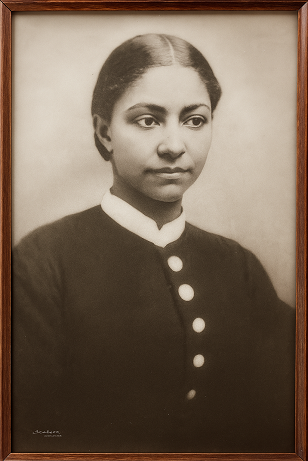
The Portrait and the Spark
My mother was walking me hand-in-hand to Miss Roscoe’s first grade classroom. It was my first day of school when I saw the black-and-white portrait of Annie M. Smith hanging outside the principal’s office at Drew-Smith Elementary School in 1957. Alongside Dr. Charles Drew, the woman’s serene image exuded a quiet dignity and pride. Together, their portraits embodied the highest ideals of Black pride—Dr. Drew, a pioneering medical scientist, and Annie Smith, a trailblazing educator—offering young minds living proof that intellect, resilience, and service were the true measures of character and achievement. At the time, I had no idea how profoundly Annie Smith’s legacy would echo in my own family’s history—or how much she had contributed to the community of Gum Springs.
The portrait presents Mrs. Smith with the serene confidence of a woman who has endured much and given even more. Her features are composed and symmetrical, her gaze direct yet contemplative, projecting a quiet authority. There is a graceful restraint in her posture and expression—neither stern nor soft, but resolutely calm, as though accustomed to bearing responsibility with dignity.
She exudes a quiet beauty, not ornamented or showy, but refined and self-possessed. The simplicity of her dress and the modest styling of her hair speak to her values: intellect, discipline, and purpose. There is in her bearing something of the educator and something of the visionary—someone who walked into Reconstruction-era classrooms not just to teach letters and numbers, but to model Black womanhood with elegance, strength, and grace.
Seen through the lens of the Gilded Age, she stands out as a “class act” in every sense: intelligent, poised, and committed to community uplift. In her expression is the quiet determination of a woman who knew the value of education, the meaning of freedom hard-won, and the burden—and blessing—of being first.
Years later, I returned to her story with new eyes discovering much more. Annie Smith wasn’t just the first Black teacher in Gum Springs. She was a wife, a farmer, a storekeeper, and a woman of remarkable independence and strength. What began as a childhood impression became a personal journey to uncover the deeper truths of her life and times.
Early Life and Marriage
Annie Maria Arnold was born on May 6, 1854, most likely in Virginia. While little is known about her childhood or early education, records confirm that she married William Dandridge Smith on January 8, 1874, in Alexandria, Virginia. [1] Smith, was West Ford’s grandson, the founder of Gum Springs, and the son of Jane Ford and Porter Smith, a blacksmith at Mount Vernon. [i]
Dandridge and Annie suffered the heartbreaking loss of their only child in infancy. Yet their marriage endured, symbolizing a union deeply rooted in community strength and resilience. The Smiths lived on adjoining parcels of land totaling nearly 27 acres, though importantly, the land was not jointly held. Annie owned nearly 15 acres, and Dandridge about 12, suggesting intentional economic independence within the marriage—a rare and telling decision for the time. [2]
Educator in a Post-Reconstruction System
Annie Smith began teaching in Gum Springs in the 1870s. The school was originally established on land donated by her mother-in-law, Jane Ford, and staffed by Quaker teachers with aid from the Freedmen’s Bureau. When federal support waned, the community stepped in. Annie was likely mentored on-site, learning through direct instruction and community support rather than formal training, as was common among Black educators in that era.[3]
It is likely Annie Smith was trained, mentored and recruited into the Freedmen’s Bureau system of teachers. Most of the white teachers recruited from up north usually lasted no more than a year. In1877, Annie Smith was 24 when Reconstruction ended with the Compromise of 1877. As a young African American woman teacher in Fairfax County, she was stepping into a hostile and paternalistic system that often questioned the competence of Black educators, underpaid them, and placed them in schools with inferior resources.
Unlike the transient teachers who came and went, Annie Smith was a daughter of the community—her roots ran deep in the very soil she taught upon, and it was this intimate bond with her neighbors and their children that sustained her unwavering commitment to their education and advancement. Despite this, teachers like Smith were central to the survival and development of Black education. Many such educators not only taught multiple grades in one-room schoolhouses but also handled administrative duties, advocated for community needs, and mentored generations of children.
By 1870 towards the end of Reconstruction when Annie was 16, Fairfax County had 13 schools for African American students and 28 for whites. The system was separate, unequal, and deliberately underfunded. Black teachers were paid less and often worked in unsafe or dilapidated buildings. Annie stood at the front of one of these classrooms, without the protections or prestige of her white counterparts—but with the resolve to teach children in a community that had long valued education as a path to liberation.
Local oral histories speak to Annie’s dedication—recounting her long journeys by foot or horseback to reach her students, her unwavering presence at the front of the classroom, and her firm yet compassionate teaching style.[4] She likely taught half a year, adapting to the seasonal rhythms of farming life. The school calendar was shorter and more fluid than today, perhaps six months on, six months off—allowing her to divide her time between education and the demands of rural subsistence.
Farming, Business, and Land Ownership
While Annie taught, she also farmed. Together, she and Dandridge operated a successful dairy farm in the 1890s, a period when dairy was a thriving industry in Fairfax County. They owned at least three horses (two attributed to Dandridge, one
[1] Alexandria, Virginia, Marriage Records, 1874.
[2] “Colored Land Tract List,” Fairfax County, 1894. Listing land tracts by race allowed white officials to monitor and limit the growth of independent Black communities like Gum Springs. Tract books served as a tool of social control, making it easier to enforce vagrancy laws, debt peonage, or discriminatory zoning.
[3] Freedmen’s Bureau Records, RG105; research.centerformasonslegacies.com.
[4] Oral history accounts from Gum Springs residents; further documentation may be available through the Gum Springs Historical Society. See Judith Saunders Burton, A History of Gum Springs, Virginia: A Report of a Case Study of Leadership in a Black Enclave. 1986. PhD diss., Peabody College for Teachers of Vanderbilt University.
[i] My connection to the West Ford legacy is one of familial interweaving through marriage. My mother’s stepfather, Bruce Saunders, was a third great-grandson of West Ford. As is common among the descendants of those once enslaved at Mount Vernon, our families are linked by a complex and enduring network of kinship. Over generations, these bonds have created a community in which many individuals are, by blood or by tradition, considered cousins—and they continue to refer to one another as such, honoring the shared legacy of resilience and connection.
[i]Conflicting accounts of the origins of education in Gum Springs reveal not a contradiction, but a layered history of community-led schooling. Freedmen’s Bureau records cite an early private school providing property to served as a schoolhouse led by Samuel K. Lee as early as 1865. Only to be burned by arsonist but swiftly relocated to the home of Charles Ford. Oral tradition credits Rev. Samuel Taylor, a formerly enslaved man, with establishing a church-based school at Bethlehem Baptist Church. Later, Jane Ford’s land donation enabled the construction of a formal schoolhouse, supported by Quaker educators. Together, these efforts mark a continuum of African American educational self-determination in the Reconstruction era.